
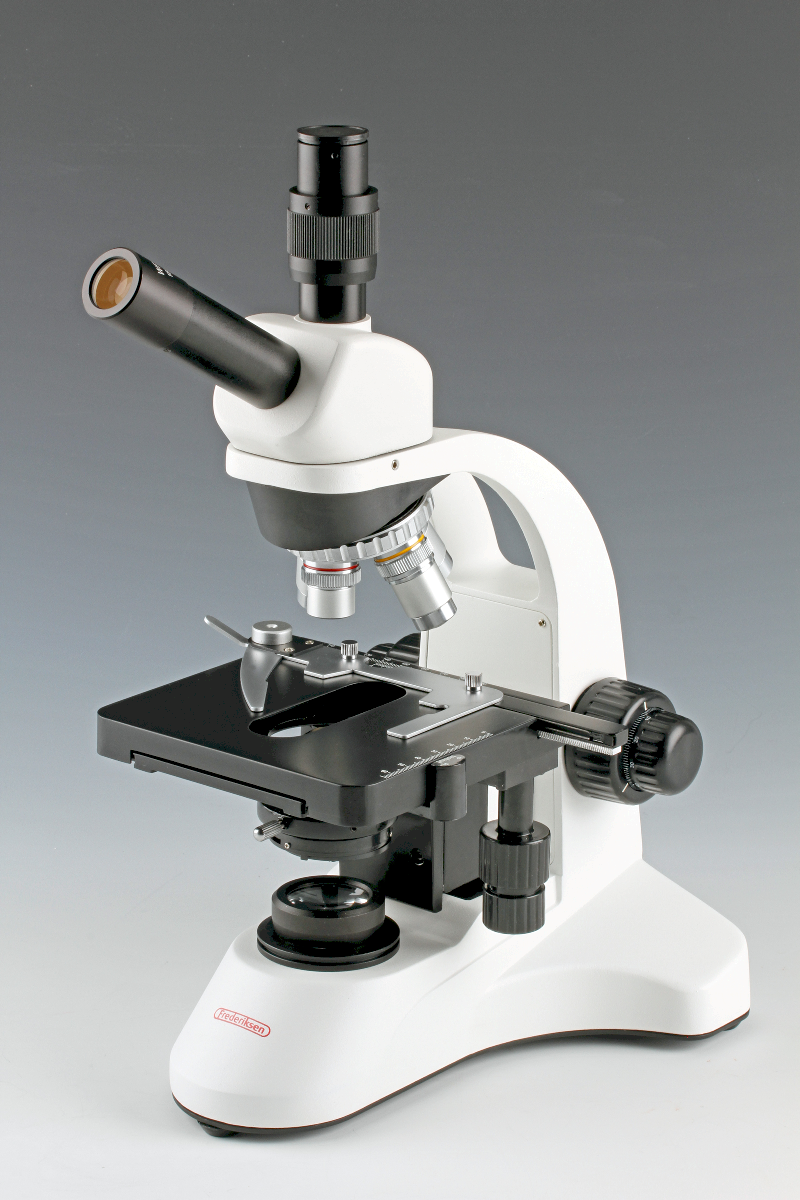
Microscope FS-1, camera tube, 60x
Monocular microscope with vertical tube for use in teaching environments where several people need to be able to look at the same object at the same time or where a camera needs to be attached for casting or image documentation. The microscope is equipped with four achromatic objectives that make it particularly suitable in situations where there is a need to look at a wide range of elements of varying size. The 10x magnification of the eyepiece together with the objectives gives a total magnification of 40x, 100x and 400x and 600x. A good choice for slightly more advanced student use in secondary schools and high schools, where the 60x objective allows observation of some of the smallest cells, as well as larger cell organelles.
Please note that the 60x objective can be used for observation of some bacteria, but is not suitable for procedures where bacteria need to be species determined. The objective provides good magnification when studying different cells from plants and animals, or blood and sperm smears.
Focusing is done with coaxial coarse and fine screws on the side of the microscope that move the cross stage up and down. The light is built-in LED lighting that is adjusted via a knob on the microscope base, while contrast and depth of field are adjusted with a condenser and aperture under the cross stage.
The FS-1, 60x microscope is also available in a monocular and a binocular version, or in a monocular and binocular version with a 100x objective as the highest magnification. The FS-1, 60x microscope is also available in a version with a rechargeable battery.
The microscope is supplied with a dust cap.
Technical data:
- Eyepiece tube: Monocular with extra vertical tube – camera connection option
- Eyepiece: 10x widefield (wide angle) in pairs/ ø18 mm
- Lens clamp: Swing arm
- Objectives: Achromatic
- 4x NA 0.10
- 10x NA 0.25
- 40x NA 0.65 (spring front)
- 60x NA 0.85 (spring front)
- Lens turret: Rear-facing with space for 4 lenses
- Magnifications: 40x, 100x, 400x, 600x
- Condenser: Abbé condenser NA 1.25 with filter holder. Adjustable in height.
- Aperture: Iris diaphragm for stepless adjustment of brightness, contrast and depth of field.
- Lighting: Built into the microscope base. 3 W LED with stepless regulation.
- Focusing: Coaxial coarse and fine adjustment.
- Specimen protection: Built-in protection against accidental destruction of micro-specimens during focusing.
- Cross table: Integrated heavy-duty cross table with low-hanging coaxial operation via coarse and fine screws
- Power cord: Power cord with power adapter
- Battery: None
- Application: Insect parts, zooplankton, phytoplankton, plant cells, animal cells, some mitotic chromosomes, cell nuclei, as well as fungi and some bacteria
Use of the product
Microscopes can be used in biology, biotechnology and nature/technology teaching, where plant cells and animal cells are examined and bacteria and fungi are spotted.
The microscope’s objective lens sizes and adjustable eyepieces also make the microscope suitable for diagnostic use in laboratories and veterinary clinics, for example when examining tissue samples, blood cells or for diagnostic analyses of feces and discharge.
Specifications
- Magnification (x): 40, 100, 400, 600
- Tube type: Monocular