Product Details
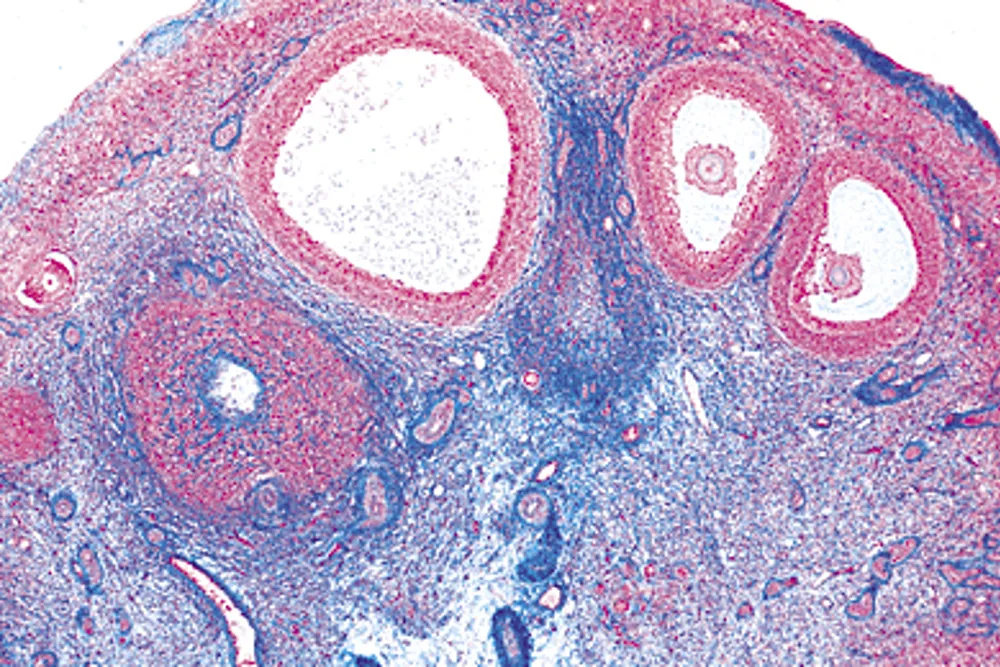
Ovary, cross-section, microscope slide
Single slide of an ovary showing the structures and cells that play a role in a woman’s follicle maturation and ovulation. The appearance of a micro-slide of the ovary is very similar to the illustrations you see in a biology book, so it does not require any medical training to find the structures and cells you have read about.
Description
All the exercise requires is a microscope that can magnify 40x and a micropreparation of ovarian tissue. The ovary contains several different cell types that are important for the correct maturation and release of the egg cell.
The following can be seen in the micrograph:
- Cross-section of an egg plant and follicles
- The egg cell
- Primary follicle
- Zona pellucida
- Secondary follicle
- Follicular cells (support cells and hormone-producing cells, respectively)
- Antrum/cavity
- The Egg Mound
- The corpus luteum and or the corpus luteum
The ovarian tissue in the preparation is stained with red and blue dyes. Some cells and tissues retain the red dye molecules best, while others retain the blue dye molecules best. This makes it easier to see the difference between the cells and the tissue.
The nuclei of the cells are the ones that retain the color best and therefore all round, elongated or almond-shaped darker structures are cell nuclei (many cell nuclei in the ovary micropreparation are reddish). In many of the cell nuclei there are smaller and darker ‘grains’. Around the cell nuclei is the cytoplasm and a cell membrane. Cells can have different shapes, such as round, oval, elongated or angular.
Use of the product
In biology, this microslide allows students to examine follicle development in the ovary and directly relate observations to the illustrations and descriptions they know from textbooks. For example, students can identify the egg cell, zona pellucida, follicular cells (supportive and hormone-producing cells), antrum/cavity, and the ovum. This provides a concrete understanding of how ovulation occurs and how different cell types interact in the maturation of the egg.