Product Details
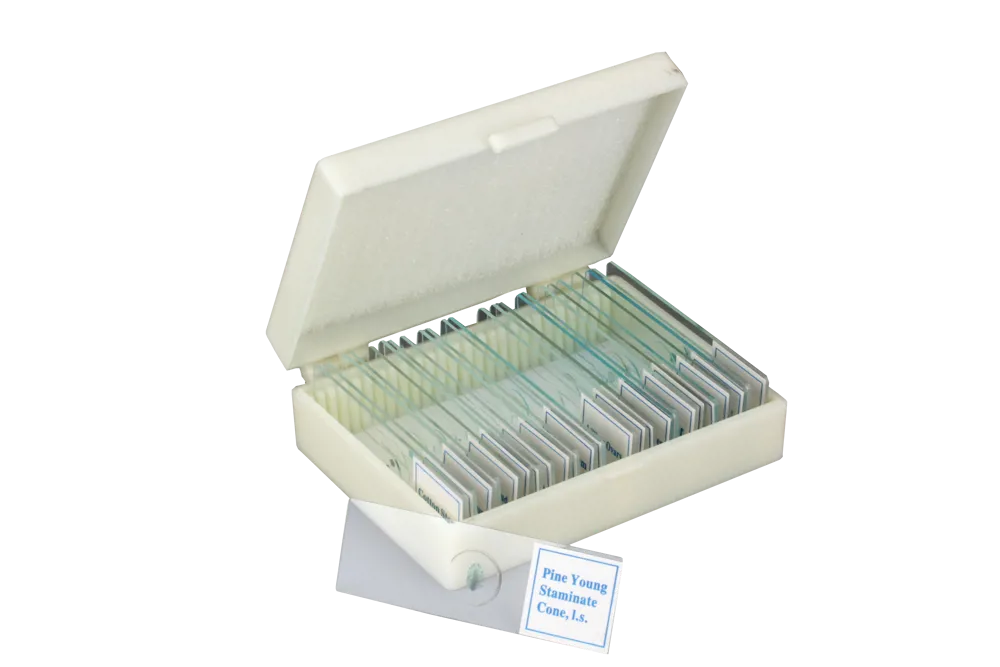
Microscope slide set, botany, 25 different
Affordable botanical basic set with 25 different micro-slides from the world of botany. The slides are mounted on glass slides and cover a wide range of plant tissues and microscopic structures that you and your students can examine under a microscope.
Description
The set is suitable for both biology lessons and introduction to microscopy. An overview of the slides can be downloaded under *Documents* and printed to fit in the box.
Basic set contains:
- Onion epidermis,WM / Epidermis, cells from onion,WM
- Mitosis onion root tip LS / Cell division in the root tip of onion LS
- Young root of broad bean CS / Cross section of broad bean root CS
- Zea stem CS / Stem from monocotyledonous plant, zea corn CS
- Pumpkin stem CS / Pumpkin stem CS
- Tilia stem CS / Stem of 3-year-old dicotyledonous plant, Lind CS
- Pine leaf CS / Pine needle, cross section CS
- Pelargonium of leaf CS / Leaf from pelargonium CS
- Leaf of winter jasmine CS / Leaf from Jasmine with slit opening CS
- Lillium anther CS / Anthers from lily CS
- Pollen germ WM / Germinating pollen grain Pollen Germ WM
- Lillium ovary CS / Fruit node from lily CS
- Pine young staminate cone LS / Fyrrekogel, ung hanbl LS
- Lichen,sec / Lichen, cross section
- Polytrichum archegonia LS / Arkegonium, egg-laying bear moss LS
- Polytrichum protonema WM/ Polytrichum protonema WM
- Yeast pudding WM / Budding, yeast WM
- Penicillium WM / Penicillium WM
- Nostoc WM / Blue-green algae, Nostos WM
- Spirogyra WM / Green algae, Spirogyra WM
- Terminal bud stem tip LS
- Stomata vicia faba leaf WM / Cleft opening on leaf horse bean WM
- Chlamydomonas WM / Green algae, Chlamydomonas WM
- Pine stem CS / Pine stem, older CS
- Cotton stem CS / Cotton stem CS
Use of the product
In biology classes, the microslide set can be used to examine everything from cell division in bulbs and germinating pollen grains to cross-sections of roots, leaves and stems from both monocotyledonous and dicotyledonous plants. This gives students the opportunity to compare different tissue types and structures across the plant kingdom. The set also contains algae, mosses, lichens and yeasts, so students gain insight into several of the botanical groups. In laboratories outside of classes, similar preparations are used for training in tissue knowledge and microscopy techniques, e.g. in connection with botany, plant physiology and biotechnological analyses.
Specifications
- Number of Parts: 25