Product Details
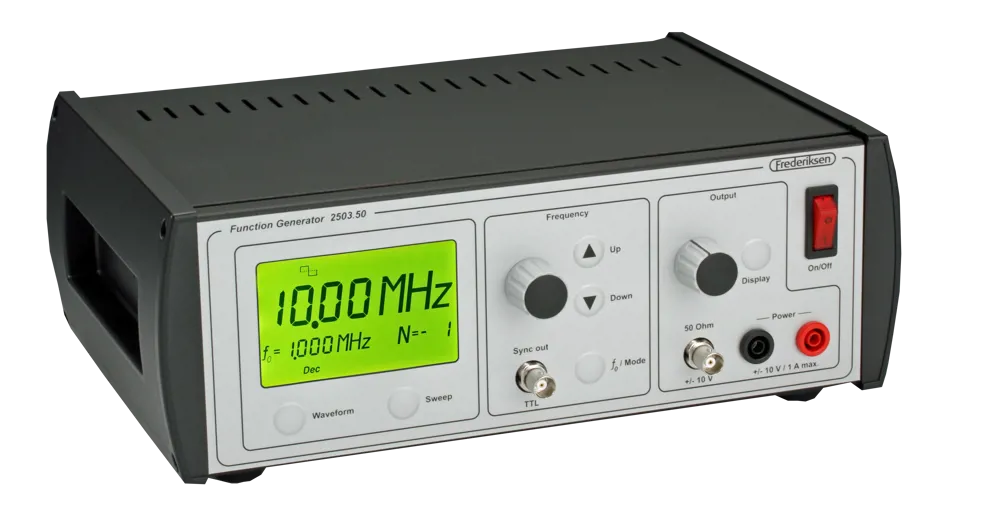
Function generator
This function generator is developed and produced by Frederiksen Scientific and is suitable for, for example, experiments with standing waves or for studying sound waves at different frequencies. The generator can run through frequencies in intervals of ten decades from 0.001 Hz to 10.00 MHz with a tolerance of just 0.005%.
Description
The generator has a built-in step function, which makes it easier to perform experiments with resonance points that include a fundamental frequency, as it can be stepped as a multiple of the reference frequency. The frequency can be set to run through a range, so that any resonances can be detected. Select the frequency range and how fast it happens. Choose between linear sweep (fixed number of Hz per time) or logarithmic sweep (fixed number of octaves per time).
Outputs: A 10 W output amplifier is connected to the outputs, which makes it possible, among other things, to use it together with the electromagnetic vibrator (218500). The amplifier can deliver more than 1 A for all frequencies between 0.001 Hz and 100 kHz. For frequencies greater than 100,000 kHz, the BNC output with an impedance of 50 Ohm can be used for oscillator circuits such as 429330.
Inputs: The generator can be connected to a PC via a standard USB cable.
Are the seven built-in waveforms insufficient? The generator has the option to insert various waveforms based on a given data base – transfer data from your PC via a USB cable, for example from a spreadsheet.
Do you need to use a specific sequence of settings over and over again? The generator can be set to do this.
If you want to specify the frequency more precisely than the display can show, the frequency can be set with a resolution of 0.001 Hz.
Use of the product
This generator is a versatile tool for teaching experiments that require control of frequencies and signal shapes. It is used, among other things, to investigate standing waves, resonance and diffraction, and to work with oscillatory circuits. The step function makes it easy to find resonance points, and the sweep function (linear or logarithmic) allows you to visualize frequency-dependent phenomena. The product is ideal for both demonstration experiments and students’ own investigations, and PC connection makes it possible to save and reuse setups.
Sturdy, universal, advanced – but easy to use.
The tone generator for any experiment with vibrations, sound and alternating currents.
Reaches from slower-than-slow all the way up to 10 MHz.
Developed for education
Our team of developers includes experienced physics teachers who ensures that technical perfection goes hand in hand with practicability.
The function generator is ideal for standing waves experiments – but tackles without problems any task a functions generator can be expected to handle.
Want to check out electronic filters at 5 – 10 MHz?
Or do you need a voltage that grows linearly from 0 to 10 V in 500 seconds?
No problem for 250350.
Unique control of the frequency
The frequency is set using a speed-sensitive button. Its characteristics have been tuned through the work with practical experiments, using a range of normal physics equipment.
You turn it slowly to set the least significant digits on the display.
If you turn it faster, the response accelerates smoothly.
The generator spans the ten decades from 0.001 Hz to 10.00 MHz in one range.
The frequency is stable within 0.005 %
Step
In many applications you want to study a physical system at a fundamental frequency as well as at multiples of this frequency.
The special step function makes this a breeze.
Sweep
The frequency can be made to sweep an area, to detect any resonances.
You can select the frequency range and the sweep speed.
You have a choice of linear sweep (a fixed number of Hz per second) or a logarithmic sweep (a fixed number of octaves per time).
Drives connected loudspeaker, vibrator, etc. directly
The built-in 10 W power amplifier drives effortless current-hungry equipment like a vibrator.
The amplifier can supply more than 1 A at all frequencies between 0.001 Hz and 100 kHz.
It is permanently connected to the generator part with no switches or external cables to make things complicated
Advanced functions
The generator can be connected to your PC as a USB memory stick (using a standard USB cable).
• Waveforms: Seven built-in waveforms not enough? Simply define your own waveform, using for instance a spreadsheet
• Are you using the same sequence of settings again and again? Program the generator to do it for you.
• Want to specify the frequency more precisely than the display allows? Set the frequency programmatically with 0.001 Hz resolution.
Specifications
Build-in waveforms
Bipolar: Sine, triangle, square
Positive: Square pulse, triangle pulse, ramp up, ramp down
Distortion (sine): < 0.1 % up to 20 kHz; < 1 % otherwise
Frequency range
50 Ω and sync outputs: 0.001 Hz to 10.00 MHz
Power output: 0.001 Hz to 100.0 kHz
Frequency stability: Better than 0.005 %
Amplitude
50 Ω output, no load: 0 to 10 V (20 V p-p for bipolar waveforms)
Sync output: 5 V (TTL signal: 0 to 5 V)
Power output: 0 to 10 V (20 V p-p for bipolar waveforms)
Max current
50 Ω output, short circuit: 200 mA (only briefly)
50 Ω output, into 50: 100 mA (unlimited)
Power output: 1 A (unlimited)
Misc.
Mains voltage:
230 V; 50-60 Hz (115 V on request: Item no. 2502.51)
Power consumption:
85 W (max) ; 21 W (idle)
Dimensions (W x D x H): 312 x 205 x 117 mm